ESP32 MicroPython TM1637 4-Digit 7-Segment Display

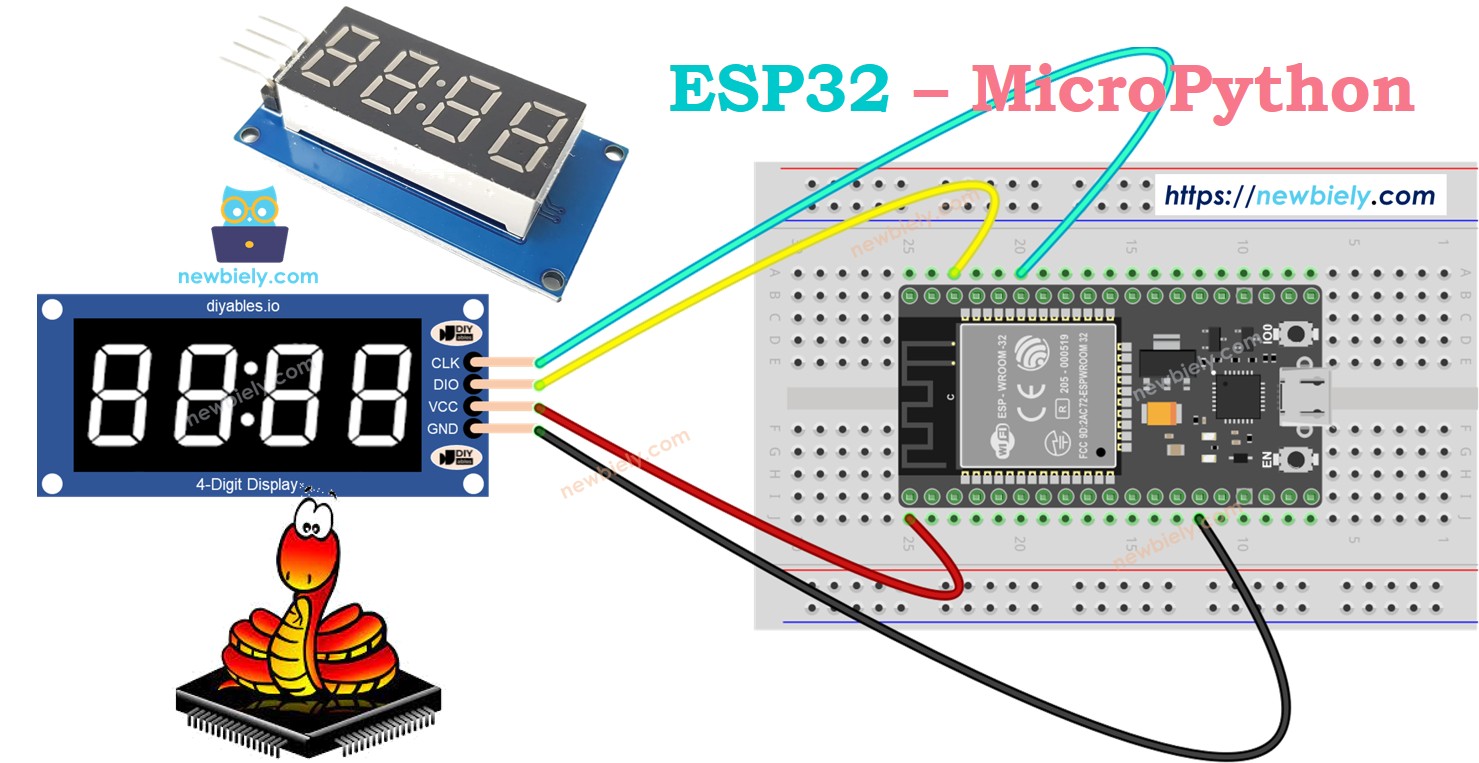
The ESP32 is a powerful, Wi-Fi-enabled microcontroller widely used in IoT and embedded projects. Paired with MicroPython and the DIYables TM1637 4-Digit 7-Segment Display Module, you can easily show numbers, text, temperature, and time on a bright LED display.

This tutorial walks you through:

ESP32 MicroPython TM1637 4-Digit 7-Segment Display

Components Needed

1×ESP-WROOM-32 Dev Module
1×Alternatively, ESP32 Uno-form board
1×Alternatively, ESP32 S3 Uno-form board
1×USB Cable Type-A to Type-C (for USB-A PC)
1×USB Cable Type-C to Type-C (for USB-C PC)
1×TM1637 4-digit 7-segment Display (colon-separated)
1×Breadboard
1×Jumper Wires
1×Recommended: Screw Terminal Expansion Board for ESP32
1×Recommended: Breakout Expansion Board for ESP32
1×Recommended: Power Splitter for ESP32

Or you can buy the following kits:

1×DIYables ESP32 Starter Kit (ESP32 included)
1×DIYables Sensor Kit (18 sensors/displays)
Disclosure: Some of the links provided in this section are Amazon affiliate links. We may receive a commission for any purchases made through these links at no additional cost to you.
Additionally, some of these links are for products from our own brand, DIYables .

The TM1637 4-Digit 7-Segment Display Module

The TM1637 is a dedicated LED driver IC that handles both the multiplexing and segment driving for up to 6 digits. This module uses it to drive a 4-digit 7-segment LED display with a colon separator between the second and third digits, making it ideal for clock and timer applications.

Unlike shift-register-based displays (such as 74HC595), the TM1637 has built-in display memory. Once you write data to the chip, it keeps the display lit automatically — no Timer interrupt or refresh loop is needed. The TM1637 also supports 8 brightness levels (0–7) and uses only 2 GPIO pins (CLK and DIO) for communication.

The module communicates via a 2-wire serial protocol similar to I2C (but not standard I2C). The library handles all protocol details — you just call simple methods like print() and print_time().

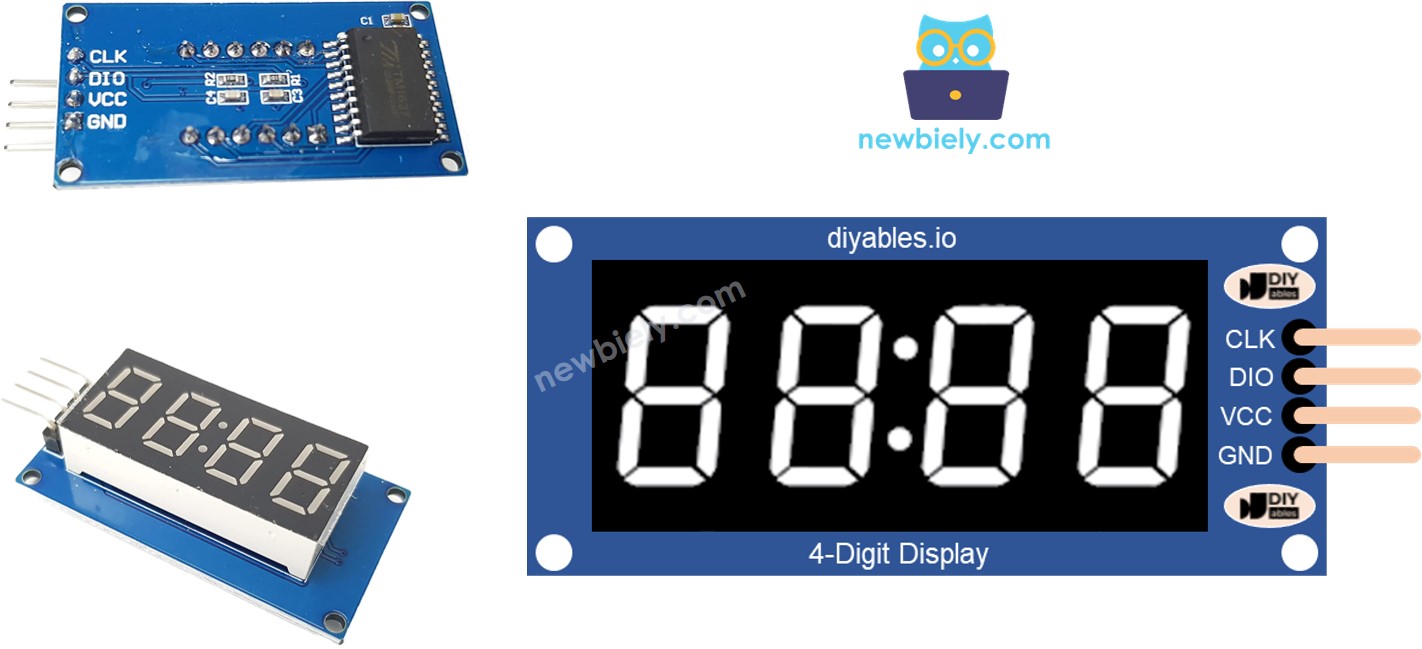
Pin Description

Pin Purpose ESP32 Connection
CLK Serial clock input Connect to GPIO21
DIO Serial data input/output Connect to GPIO22
VCC 3.3V to 5V power input Connect to 3.3V
GND Ground Connect to GND
TM1637 4-Digit 7-Segment Display Pinout

Wiring

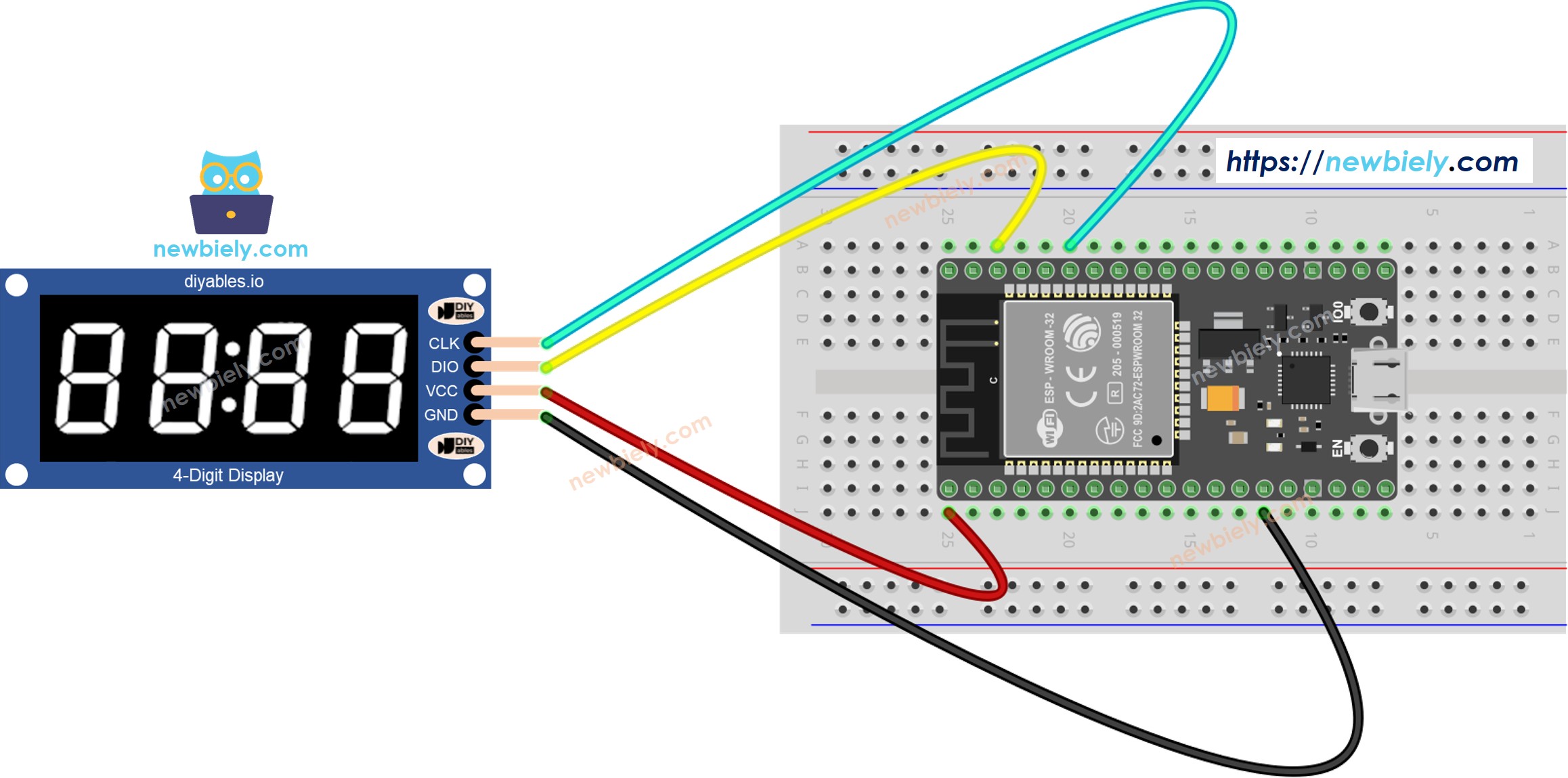
The ESP32 operates at 3.3V logic. The TM1637 module works with both 3.3V and 5V, so it is directly compatible with the ESP32 without any level shifter.

TM1637 Module ESP32 Notes
CLK GPIO21 Clock line
DIO GPIO22 Data I/O line
VCC 3.3V Power
GND GND Ground
The wiring diagram between ESP32 TM1637 4-Digit 7-Segment Display

This image is created using Fritzing. Click to enlarge image

Tip: You can use any available GPIO pins on the ESP32. Just update the pin numbers in the code.

Detailed Instructions

Here's instructions on how to set up and run your MicroPython code on the ESP32 using Thonny IDE:

  • Make sure Thonny IDE is installed on your computer.
  • Confirm that MicroPython firmware is loaded on your ESP32 board.
  • If this is your first time using an ESP32 with MicroPython, check out the ESP32 MicroPython Getting Started guide for step-by-step instructions.
  • Connect the ESP32 board to the TM1637 module according to the provided diagram.
  • Connect the ESP32 board to your computer with a USB cable.
  • Open Thonny IDE on your computer.
  • In Thonny IDE, go to Tools Options.
  • Under the Interpreter tab, choose MicroPython (ESP32) from the dropdown menu.
  • Make sure the correct port is selected. Thonny IDE usually detects it automatically, but you might need to select it manually (like COM3 on Windows or /dev/ttyUSB0 on Linux).
  • Navigate to the Tools Manage packages on the Thonny IDE.
  • Search "DIYables-MicroPython-4Digit7Segment-TM1637", then find the TM1637 4-Digit 7-Segment Display library created by DIYables.
  • Click on DIYables-MicroPython-4Digit7Segment-TM1637, then click Install button to install the library.
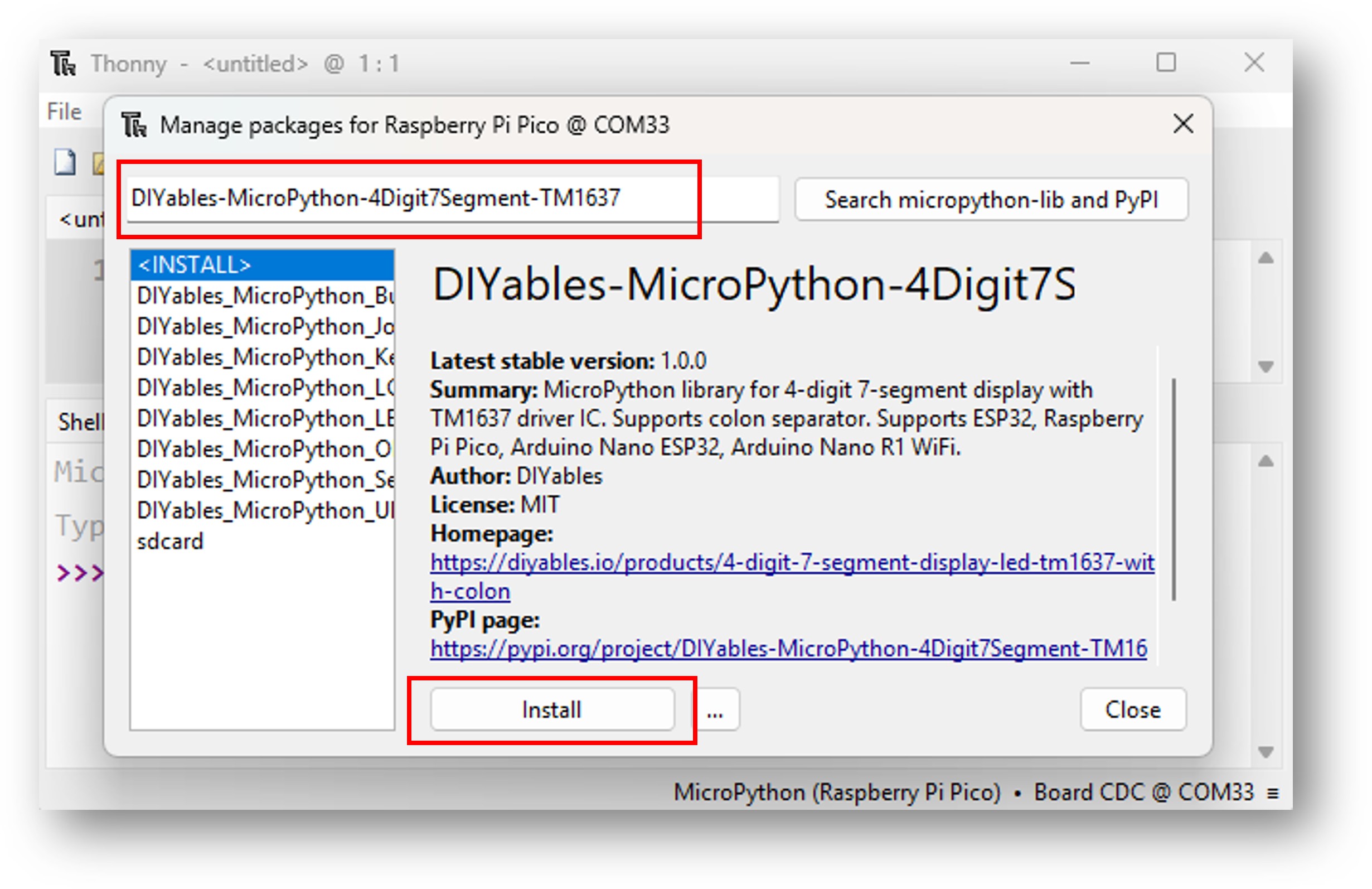
ESP32 TM1637 4-Digit 7-Segment Display library
  • Copy the provided MicroPython code and paste it into Thonny's editor.
  • Save the code to your ESP32 by:
    • Clicking the Save button or pressing Ctrl+S.
    • In the save dialog, choose MicroPython device.
    • Name the file main.py.
  • Click the green Run button (or press F5) to execute the script.
  • Observe the result — the 4-digit 7-segment display shows numbers, text, or time depending on the example.

Starter Code Template

from DIYables_MicroPython_4Digit7Segment_TM1637 import Display4Digit7SegmentTM1637 import time display = Display4Digit7SegmentTM1637(clk_pin=21, dio_pin=22) #Display stays on automatically — no refresh loop needed display.print(1234)

ESP32 Code — Display Integers

""" Example: Display integer numbers on 4-digit 7-segment display with TM1637. Works with: ESP32, Raspberry Pi Pico, Arduino Nano ESP32, Arduino Nano R1 WiFi Product page: https://diyables.io/products/4-digit-7-segment-display-led-tm1637-with-colon Wiring guide: ESP32: TM1637 Module ESP32 ───────────── ────── CLK -> GPIO21 DIO -> GPIO22 VCC -> 3.3V GND -> GND Raspberry Pi Pico: TM1637 Module Raspberry Pi Pico ───────────── ───────────────── CLK -> GP1 DIO -> GP0 VCC -> 3.3V (pin 36) GND -> GND (pin 38) Arduino Nano ESP32: TM1637 Module Arduino Nano ESP32 ───────────── ────────────────── CLK -> D21 (GPIO21) DIO -> D22 (GPIO22) VCC -> 3.3V GND -> GND Arduino Nano RP2040 Connect: TM1637 Module Arduino Nano RP2040 Connect ───────────── ─────────────────────────── CLK -> D1 (GP1) DIO -> D0 (GP0) VCC -> 3.3V GND -> GND """ from DIYables_MicroPython_4Digit7Segment_TM1637 import Display4Digit7SegmentTM1637 import time # Pin configuration - change the pins to match your wiring and board # ESP32 / Arduino Nano ESP32: CLK=21, DIO=22 # Raspberry Pi Pico / Nano RP2040: CLK=1, DIO=0 CLK_PIN = 21 DIO_PIN = 22 display = Display4Digit7SegmentTM1637(CLK_PIN, DIO_PIN) while True: # Display integers numbers = [0, 42, 1234, -5, -123, 9999] for num in numbers: display.print(num) time.sleep(2) # Display with zero padding display.print(42, zero_pad=True) # Shows "0042" time.sleep(2)

Try It

  • Wire the module, connect the ESP32 via USB.
  • Upload the code using Thonny IDE.
  • The display cycles through several integers (0, 42, 1234, -5, -123, 9999), then shows zero-padded 42 as "0042".

Integer Display Reference

Method Call Display Shows Notes
display.print(0) 0 Right-aligned single digit
display.print(42) 42 Right-aligned
display.print(1234) 1234 All 4 digits used
display.print(-5) -5 Negative sign + digit
display.print(-123) -123 Max 3-digit negative
display.print(9999) 9999 Maximum displayable value
display.print(10000) Err Overflow error
display.print(42, zero_pad=True) 0042 Zero-padded to 4 digits

ESP32 Code — Display Text, Degree, and Temperature

""" Example: Display text, special characters, and temperature on 4-digit 7-segment display. Works with: ESP32, Raspberry Pi Pico, Arduino Nano ESP32, Arduino Nano R1 WiFi Product page: https://diyables.io/products/4-digit-7-segment-display-led-tm1637-with-colon Wiring guide: ESP32: TM1637 Module ESP32 ───────────── ────── CLK -> GPIO21 DIO -> GPIO22 VCC -> 3.3V GND -> GND Raspberry Pi Pico: TM1637 Module Raspberry Pi Pico ───────────── ───────────────── CLK -> GP1 DIO -> GP0 VCC -> 3.3V (pin 36) GND -> GND (pin 38) Arduino Nano ESP32: TM1637 Module Arduino Nano ESP32 ───────────── ────────────────── CLK -> D21 (GPIO21) DIO -> D22 (GPIO22) VCC -> 3.3V GND -> GND Arduino Nano RP2040 Connect: TM1637 Module Arduino Nano RP2040 Connect ───────────── ─────────────────────────── CLK -> D1 (GP1) DIO -> D0 (GP0) VCC -> 3.3V GND -> GND """ from DIYables_MicroPython_4Digit7Segment_TM1637 import Display4Digit7SegmentTM1637 import time # Pin configuration - change the pins to match your wiring and board # ESP32 / Arduino Nano ESP32: CLK=21, DIO=22 # Raspberry Pi Pico / Nano RP2040: CLK=1, DIO=0 CLK_PIN = 21 DIO_PIN = 22 display = Display4Digit7SegmentTM1637(CLK_PIN, DIO_PIN) while True: # Display text strings texts = ["HELP", "Hi", "COOL", "done"] for text in texts: display.print(text) time.sleep(2) # Display temperature with degree symbol display.print_temperature(25, 'C') # Shows "25°C" time.sleep(2) display.print_temperature(72, 'F') # Shows "72°F" time.sleep(2) # Display string with degree constant display.print("25" + display.DEGREE + "C") # Same as print_temperature(25, 'C') time.sleep(2)

Text and Temperature Reference

Method Call Display Shows Notes
display.print("HELP") HELP Text display
display.print("Hi") Hi Left-aligned, 2 chars
display.print("COOL") COOL 4 characters
display.print_temperature(25, 'C') 25°C Celsius with degree symbol
display.print_temperature(72, 'F') 72°F Fahrenheit
display.print_temperature(-5, 'C') -5°C Negative temperature
display.print_temperature(100) 100° 3-digit, no room for unit

The degree symbol can also be used directly in strings via the display.DEGREE constant.

ESP32 Code — Display Time with Blinking Colon

""" Example: Display time with blinking colon separator on 4-digit 7-segment display. This module has a colon separator between digit 1 and digit 2, ideal for clock display. Works with: ESP32, Raspberry Pi Pico, Arduino Nano ESP32, Arduino Nano R1 WiFi Product page: https://diyables.io/products/4-digit-7-segment-display-led-tm1637-with-colon Wiring guide: ESP32: TM1637 Module ESP32 ───────────── ────── CLK -> GPIO21 DIO -> GPIO22 VCC -> 3.3V GND -> GND Raspberry Pi Pico: TM1637 Module Raspberry Pi Pico ───────────── ───────────────── CLK -> GP1 DIO -> GP0 VCC -> 3.3V (pin 36) GND -> GND (pin 38) Arduino Nano ESP32: TM1637 Module Arduino Nano ESP32 ───────────── ────────────────── CLK -> D21 (GPIO21) DIO -> D22 (GPIO22) VCC -> 3.3V GND -> GND Arduino Nano RP2040 Connect: TM1637 Module Arduino Nano RP2040 Connect ───────────── ─────────────────────────── CLK -> D1 (GP1) DIO -> D0 (GP0) VCC -> 3.3V GND -> GND """ from DIYables_MicroPython_4Digit7Segment_TM1637 import Display4Digit7SegmentTM1637 import time # Pin configuration - change the pins to match your wiring and board # ESP32 / Arduino Nano ESP32: CLK=21, DIO=22 # Raspberry Pi Pico / Nano RP2040: CLK=1, DIO=0 CLK_PIN = 21 DIO_PIN = 22 display = Display4Digit7SegmentTM1637(CLK_PIN, DIO_PIN) hours = 12 minutes = 30 colon_on = True while True: display.print_time(hours, minutes, colon=colon_on) time.sleep(0.5) # Toggle colon every 500ms for blinking effect colon_on = not colon_on

Time Display Reference

Method Call Display Shows Notes
display.print_time(12, 30) 1230 Colon ON
display.print_time(9, 5) 0905 Zero-padded hours and minutes
display.print_time(12, 30, colon=False) 12 30 Colon OFF (for blinking effect)

Toggle the colon parameter every 500ms to create a blinking colon effect, commonly seen on clock displays.

ESP32 Code — Set Individual Digits and Colon

""" Example: Set individual digits and colon on 4-digit 7-segment display with TM1637. Works with: ESP32, Raspberry Pi Pico, Arduino Nano ESP32, Arduino Nano R1 WiFi Product page: https://diyables.io/products/4-digit-7-segment-display-led-tm1637-with-colon Wiring guide: ESP32: TM1637 Module ESP32 ───────────── ────── CLK -> GPIO21 DIO -> GPIO22 VCC -> 3.3V GND -> GND Raspberry Pi Pico: TM1637 Module Raspberry Pi Pico ───────────── ───────────────── CLK -> GP1 DIO -> GP0 VCC -> 3.3V (pin 36) GND -> GND (pin 38) Arduino Nano ESP32: TM1637 Module Arduino Nano ESP32 ───────────── ────────────────── CLK -> D21 (GPIO21) DIO -> D22 (GPIO22) VCC -> 3.3V GND -> GND Arduino Nano RP2040 Connect: TM1637 Module Arduino Nano RP2040 Connect ───────────── ─────────────────────────── CLK -> D1 (GP1) DIO -> D0 (GP0) VCC -> 3.3V GND -> GND """ from DIYables_MicroPython_4Digit7Segment_TM1637 import Display4Digit7SegmentTM1637 import time # Pin configuration - change the pins to match your wiring and board # ESP32 / Arduino Nano ESP32: CLK=21, DIO=22 # Raspberry Pi Pico / Nano RP2040: CLK=1, DIO=0 CLK_PIN = 21 DIO_PIN = 22 display = Display4Digit7SegmentTM1637(CLK_PIN, DIO_PIN) while True: # Set individual numbers on each digit position display.clear() display.set_number(0, 1) display.set_number(1, 2) display.set_number(2, 3) display.set_number(3, 4) # Display shows "1234" time.sleep(2) # Turn colon on — display shows "12:34" display.set_colon(True) time.sleep(2) # Turn colon off — display shows "1234" display.set_colon(False) time.sleep(2) # Set individual characters on each digit position display.clear() display.set_char(0, 'H') display.set_char(1, 'E') display.set_char(2, 'L') display.set_char(3, 'P') # Display shows "HELP" time.sleep(2) # Mix characters and numbers with colon display.clear() display.set_char(0, 'A') display.set_number(1, 3) display.set_char(2, 'b') display.set_number(3, 7) display.set_colon(True) # Display shows "A3:b7" time.sleep(2) # Blinking colon effect with individual digits display.clear() display.set_number(0, 1) display.set_number(1, 2) display.set_number(2, 3) display.set_number(3, 0) for _ in range(5): # Blink 5 times display.set_colon(True) time.sleep(0.5) display.set_colon(False) time.sleep(0.5) time.sleep(1)

Individual Digits Reference

Method Call Description
display.set_number(position, number) Set a single digit (0-9) at position 0-3
display.set_char(position, char) Set a character at position 0-3
display.set_colon(True) Turn on the colon between digit 1 and digit 2
display.set_colon(False) Turn off the colon

You can mix set_number(), set_char(), and set_colon() to build custom displays digit by digit.

Library Reference

See DIYables_MicroPython_4Digit7Segment_TM1637 Library Reference for the complete API documentation including all constructors, methods, and constants.

Next Steps

  • Combine with a DS3231 RTC module to build a real-time clock.
  • Add a DHT11/DHT22 sensor to display live temperature readings.
  • Use buttons to switch between clock mode and temperature mode.

※ OUR MESSAGES

  • As freelancers, We are AVAILABLE for HIRE. See how to outsource your project to us
  • Please feel free to share the link of this tutorial. However, Please do not use our content on any other websites. We invested a lot of effort and time to create the content, please respect our work!