Arduino UNO Q - Solenoid Lock

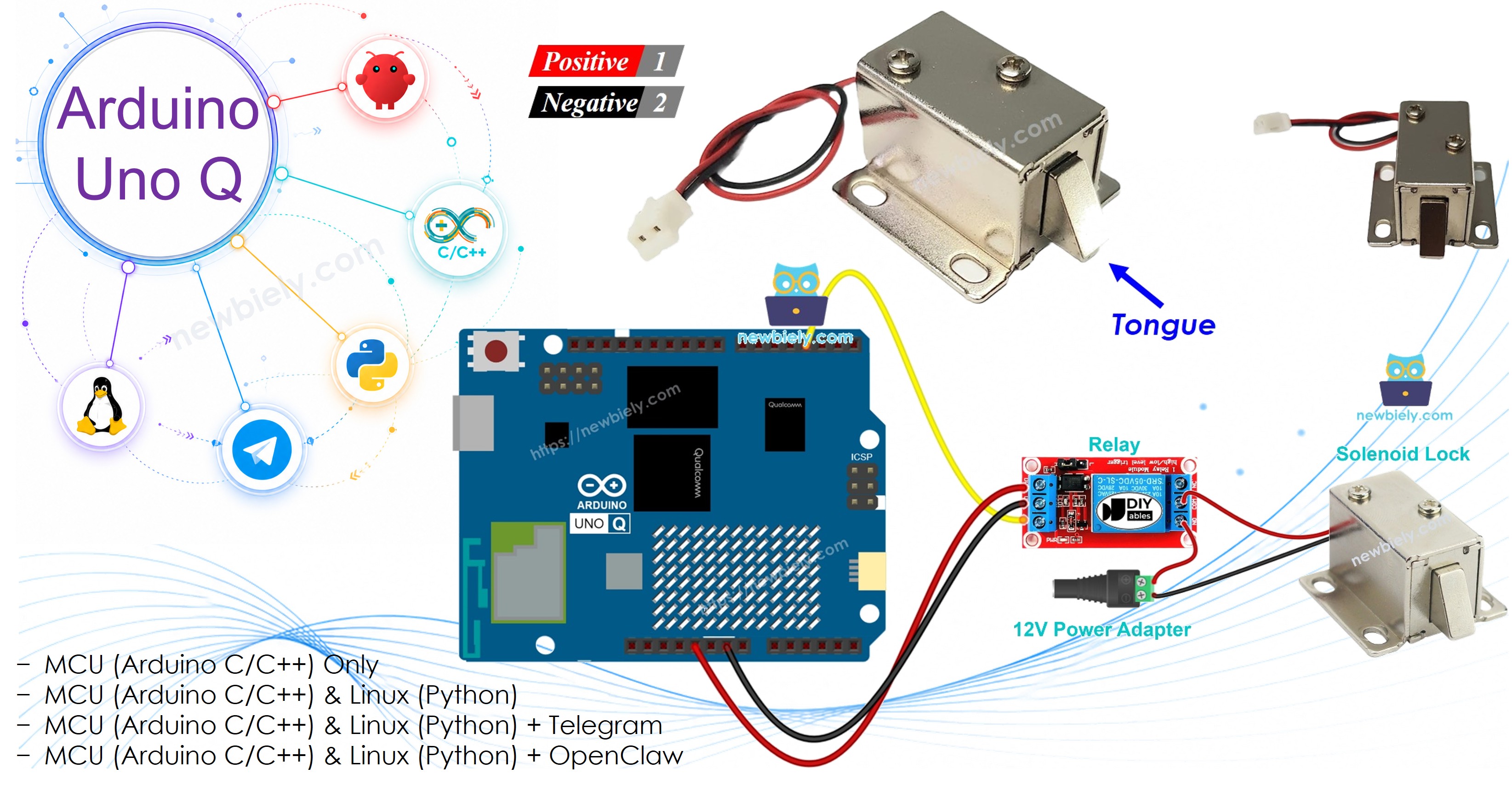
A solenoid lock (also called an electric strike lock) is powered by 12V DC and controlled through a relay. Arduino UNO Q can lock and unlock a door, cabinet, or drawer automatically — and with Bridge and Telegram, you can control the lock remotely from anywhere.

In this tutorial, you will learn:

Arduino UNO Q Solenoid Lock

Hardware Preparation

1×Arduino UNO Q
1×USB Cable for Arduino Uno Q
1×Solenoid Lock
1×Relay
1×12V Power Adapter
1×DC Power Jack
1×Jumper Wires
1×Recommended: Screw Terminal Block Shield for Arduino Uno
1×Recommended: Sensors/Servo Expansion Shield for Arduino Uno
1×Recommended: Breadboard Shield for Arduino Uno
1×Recommended: Enclosure for Arduino Uno
1×Recommended: Prototyping Base Plate & Breadboard Kit for Arduino UNO

Or you can buy the following kits:

1×DIYables Sensor Kit (18 sensors/displays)
Disclosure: Some of the links provided in this section are Amazon affiliate links. We may receive a commission for any purchases made through these links at no additional cost to you.
Additionally, some of these links are for products from our own brand, DIYables .

Overview of the Solenoid Lock

Pinout

The solenoid lock has two wires:

  • Positive (+) red wire: Connect to the 12V DC power supply
  • Negative (-) black wire: Connect to the GND of the 12V DC power supply
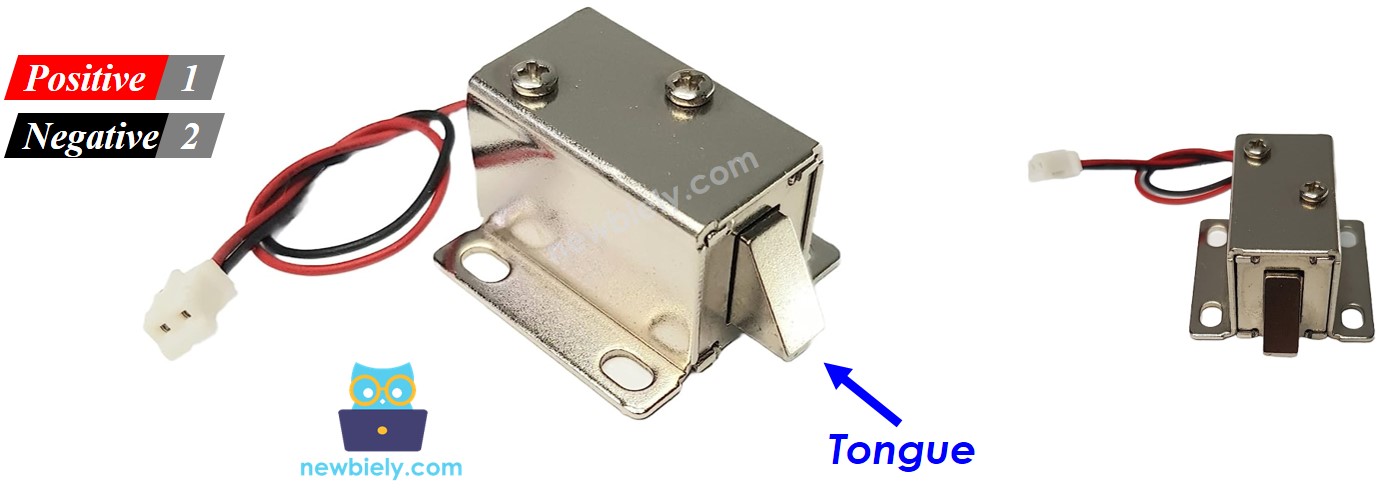
Solenoid Lock Pinout

How It Works

  • When the solenoid lock receives power → the lock tongue extends → the door is locked
  • When the solenoid lock has no power → the lock tongue retracts → the door is unlocked

※ NOTE THAT:

The solenoid lock requires 12V DC — it must NEVER be connected directly to an Arduino UNO Q pin. Always use a relay as an intermediary. The relay is controlled by the MCU and switches the 12V supply to the solenoid lock.

When the relay is wired in the normally open configuration:

  • Relay open (pin LOW) → no power to lock → door unlocked
  • Relay closed (pin HIGH) → power to lock → door locked

For the unlock state (HIGH) and lock state (LOW), refer to the code — the mapping depends on your relay module type (active-HIGH or active-LOW).

Wiring Diagram
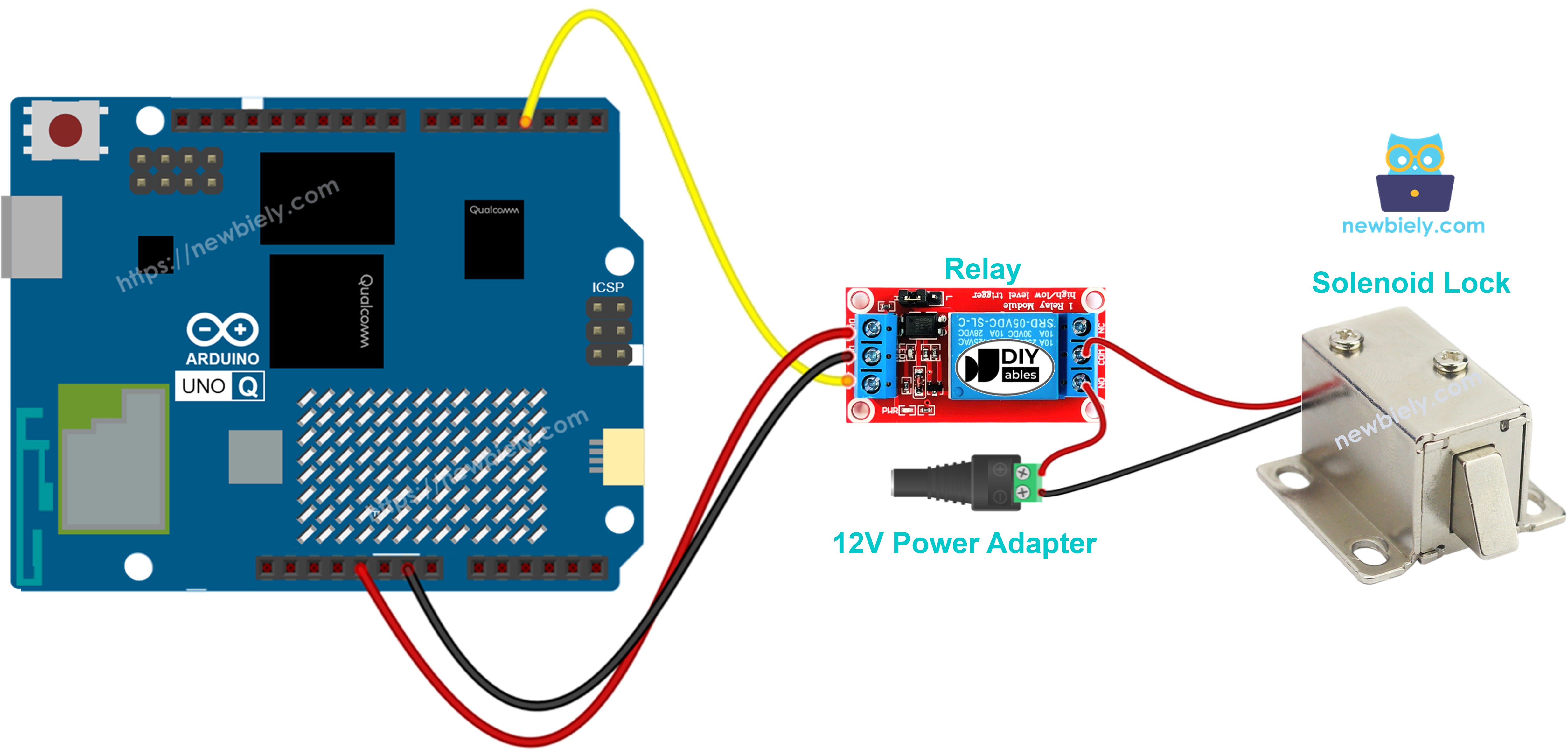
The wiring diagram between Arduino UNO Q Solenoid Lock

This image is created using Fritzing. Click to enlarge image

Connect the relay module IN pin to MCU pin D3. Connect the relay's COM and NO terminals between the 12V supply and solenoid lock. Connect the relay's VCC to 5V and GND to GND.

Relay Pin Arduino UNO Q MCU
GND GND
VCC 5V
IN D3

How To Program For Solenoid Lock

  • Set up the relay pin as output:
pinMode(RELAY_PIN, OUTPUT);
  • Unlock and lock the solenoid:
digitalWrite(RELAY_PIN, HIGH); // unlock delay(5000); digitalWrite(RELAY_PIN, LOW); // lock

Arduino UNO Q Code

The Arduino UNO Q has two processors working together:

  • The STM32 MCU controls the relay that switches power to the solenoid lock — all timing and state logic runs on the MCU
  • The Qualcomm MPU runs Debian Linux and handles Wi-Fi, Python, and cloud connectivity
  • In this section, only the MCU is programmed — the Linux side stays idle. A later section shows how both processors work together via Bridge.

This code unlocks the solenoid lock for 5 seconds, then locks it again — repeating continuously.

/* * This Arduino UNO Q code was developed by newbiely.com * * This Arduino UNO Q code is made available for public use without any restriction * * For comprehensive instructions and wiring diagrams, please visit: * https://newbiely.com/tutorials/arduino-uno-q/arduino-uno-q-solenoid-lock */ // COPYRIGHT newbiely.com // AUTHOR: newbiely // This code is made available for public use without restriction. // For complete instructions, tutorials, and further information, visit: // https://newbiely.com/tutorials/arduino-uno-q/arduino-uno-q-solenoid-lock // This code locks and unlocks the solenoid lock every 5 seconds. // The relay is connected to the solenoid lock which requires a 12V power supply. #define RELAY_PIN 3 // The Arduino UNO Q MCU pin connected to the relay IN pin void setup() { Serial.begin(9600); pinMode(RELAY_PIN, OUTPUT); Serial.println("Arduino UNO Q Solenoid Lock ready"); } void loop() { Serial.println("Unlocking..."); digitalWrite(RELAY_PIN, HIGH); // unlock the door delay(5000); Serial.println("Locking..."); digitalWrite(RELAY_PIN, LOW); // lock the door delay(5000); }

Detailed Instructions

First time with Arduino UNO Q? Follow the Getting Started with Arduino UNO Q tutorial before proceeding.

  • Connect: Wire the solenoid lock, relay, and 12V power supply to the Arduino UNO Q MCU as shown in the wiring diagram.
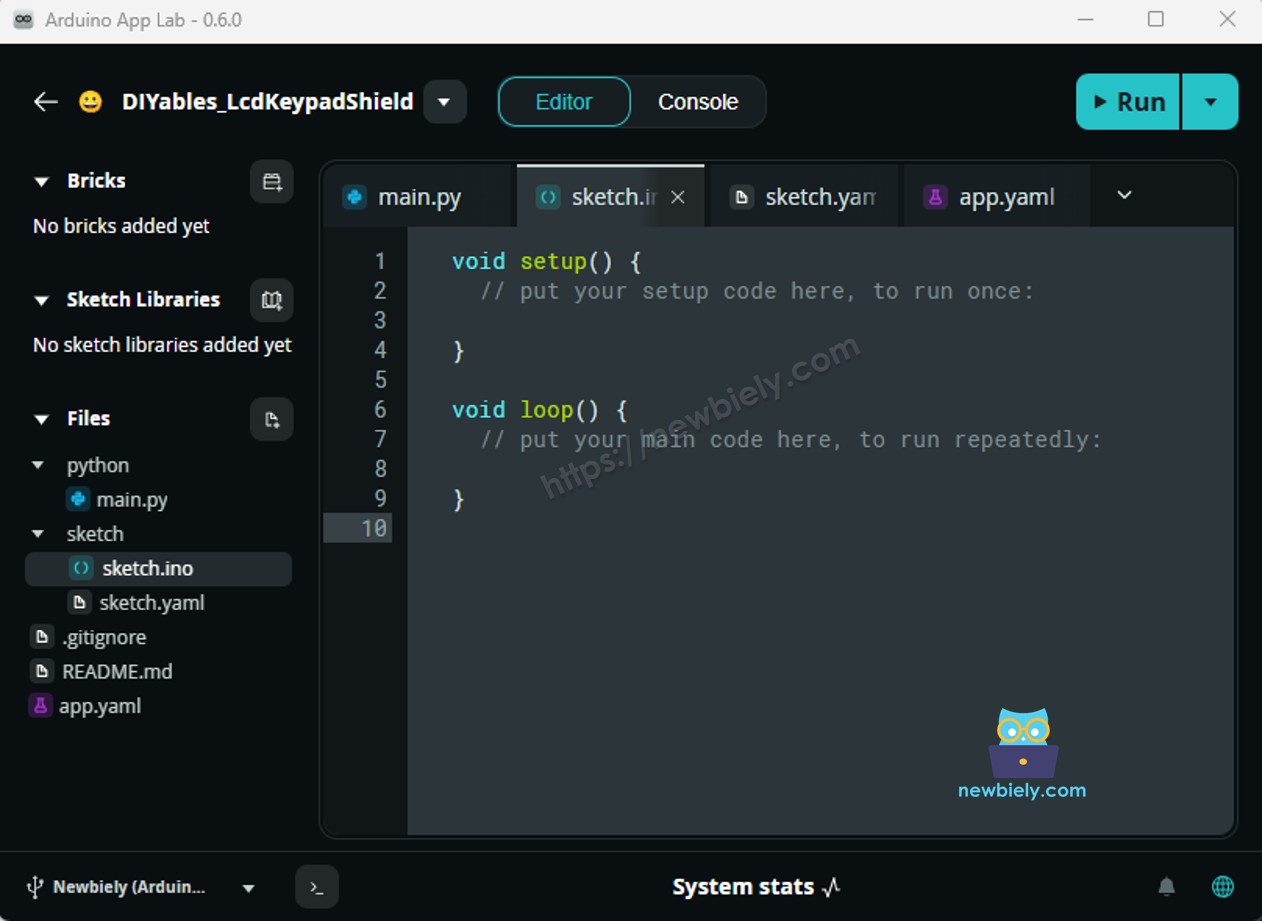
  • Open Arduino App Lab: Launch Arduino App Lab and wait until it detects your Arduino UNO Q.
  • Create a new App: Click the Create New App button.
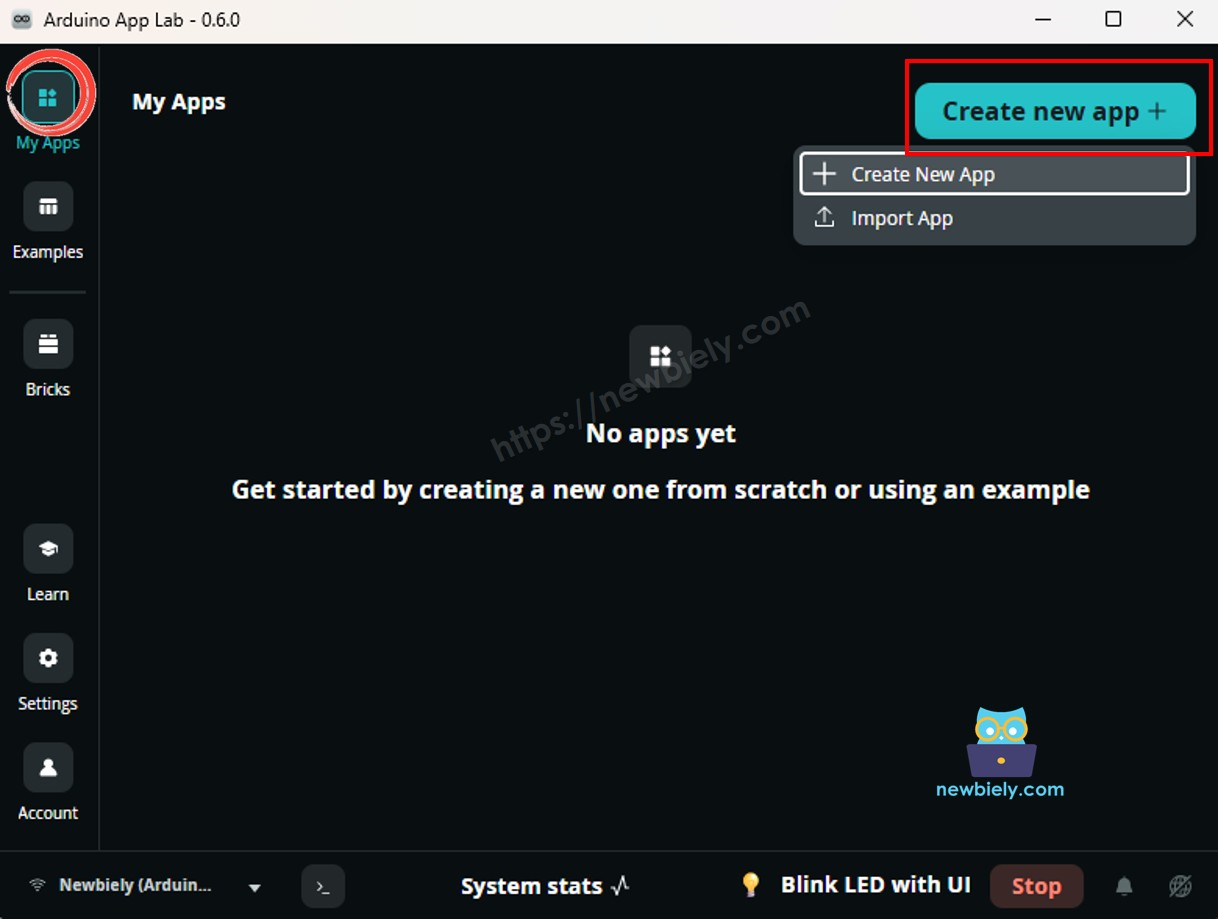
Create New App in Arduino App Lab on Arduino UNO Q
  • Give the App a name, for example: SolenoidLock
  • Click Create to confirm.
Arduino App Lab App folders and files on Arduino UNO Q
  • Paste the sketch: Copy the MCU code above and paste it into sketch/sketch.ino. Keep other files as default.
  • No library required — uses only the built-in digitalWrite() function.
  • Upload: Click the Run button in Arduino App Lab.
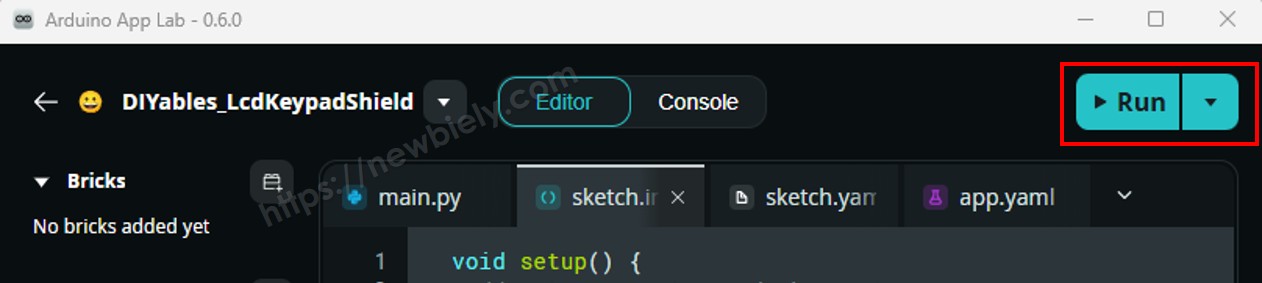
Click Run button in Arduino App Lab on Arduino UNO Q
  • Observe the solenoid lock alternating between locked and unlocked every 5 seconds.

App Lab Console Output

DIYables_Apps
Stop
sketch.ino
1#include "Arduino_RouterBridge.h"
Serial Monitor
Python
Message (Enter to send a message to "Newbiely" on usb(2820070321))
New Line
9600 baud
[2026-04-29 09:00:01] Arduino UNO Q Solenoid Lock ready [2026-04-29 09:00:01] Unlocking... [2026-04-29 09:00:06] Locking... [2026-04-29 09:00:11] Unlocking... [2026-04-29 09:00:16] Locking...

Bridge: Linux + MCU

This section shows how to program both processors of the Arduino UNO Q so the Linux side can lock and unlock the solenoid lock via Bridge:

  • The solenoid lock is connected to the MCU via relay — the MCU controls the relay output pin
  • The MPU cannot control the relay directly — it calls Bridge functions to lock or unlock
  • The MPU has Wi-Fi — running full Debian Linux, it can accept commands from Telegram or any web service and translate them into lock/unlock actions
  • Arduino_RouterBridge enables RPC communication between the two processors
  • ⚠️ /dev/ttyHS1 (Linux) and Serial1 (MCU) are RESERVED by the router — never open them in user code

In short: MPU receives lock/unlock commands → calls Bridge → MCU controls relay → solenoid lock activates.

MCU Code (Bridge)

/* * This Arduino UNO Q code was developed by newbiely.com * * This Arduino UNO Q code is made available for public use without any restriction * * For comprehensive instructions and wiring diagrams, please visit: * https://newbiely.com/tutorials/arduino-uno-q/arduino-uno-q-solenoid-lock */ // COPYRIGHT newbiely.com // AUTHOR: newbiely // This code is made available for public use without restriction. // For complete instructions, tutorials, and further information, visit: // https://newbiely.com/tutorials/arduino-uno-q/arduino-uno-q-solenoid-lock #include "Arduino_RouterBridge.h" #define RELAY_PIN 3 // The Arduino UNO Q MCU pin connected to the relay IN pin bool is_unlocked = false; String unlock(String arg) { digitalWrite(RELAY_PIN, HIGH); is_unlocked = true; Monitor.println("Solenoid lock: UNLOCKED"); return "unlocked"; } String lock(String arg) { digitalWrite(RELAY_PIN, LOW); is_unlocked = false; Monitor.println("Solenoid lock: LOCKED"); return "locked"; } String get_state(String arg) { return is_unlocked ? "unlocked" : "locked"; } void setup() { Bridge.begin(); Monitor.begin(); pinMode(RELAY_PIN, OUTPUT); digitalWrite(RELAY_PIN, LOW); // start locked Bridge.provide_safe("unlock", unlock); Bridge.provide_safe("lock", lock); Bridge.provide("get_state", get_state); Monitor.println("Arduino UNO Q Solenoid Lock Bridge ready"); Monitor.println("Initial state: LOCKED"); } void loop() {}

Python Code (Bridge)

/* * This Arduino UNO Q code was developed by newbiely.com * * This Arduino UNO Q code is made available for public use without any restriction * * For comprehensive instructions and wiring diagrams, please visit: * https://newbiely.com/tutorials/arduino-uno-q/arduino-uno-q-solenoid-lock */ # COPYRIGHT newbiely.com # AUTHOR: newbiely # This code is made available for public use without restriction. # For complete instructions, tutorials, and further information, visit: # https://newbiely.com/tutorials/arduino-uno-q/arduino-uno-q-solenoid-lock from arduino.app_utils import * import time def loop(): state = Bridge.call("get_state") print(f"Lock state: {state}") # Example: unlock for 5 seconds, then lock again if state == "locked": print("Unlocking...") Bridge.call("unlock") time.sleep(5) print("Locking...") Bridge.call("lock") time.sleep(1) App.run(user_loop=loop)

Detailed Instructions

  • Connect: Wire the solenoid lock, relay, and 12V power supply to the Arduino UNO Q as shown in the wiring diagram.
  • Open Arduino App Lab: Launch Arduino App Lab and wait for the board to be detected.
  • Create a new App: Click Create New App, name it SolenoidLockBridge, then click Create.
  • Paste the MCU sketch: Copy the MCU Bridge code above and paste it into sketch/sketch.ino.
  • Paste the Python code: Copy the Python Bridge code above and paste it into the Python file in the App.
  • Install the library: Click the Add sketch library button (the open book icon with a + sign) in the left sidebar.
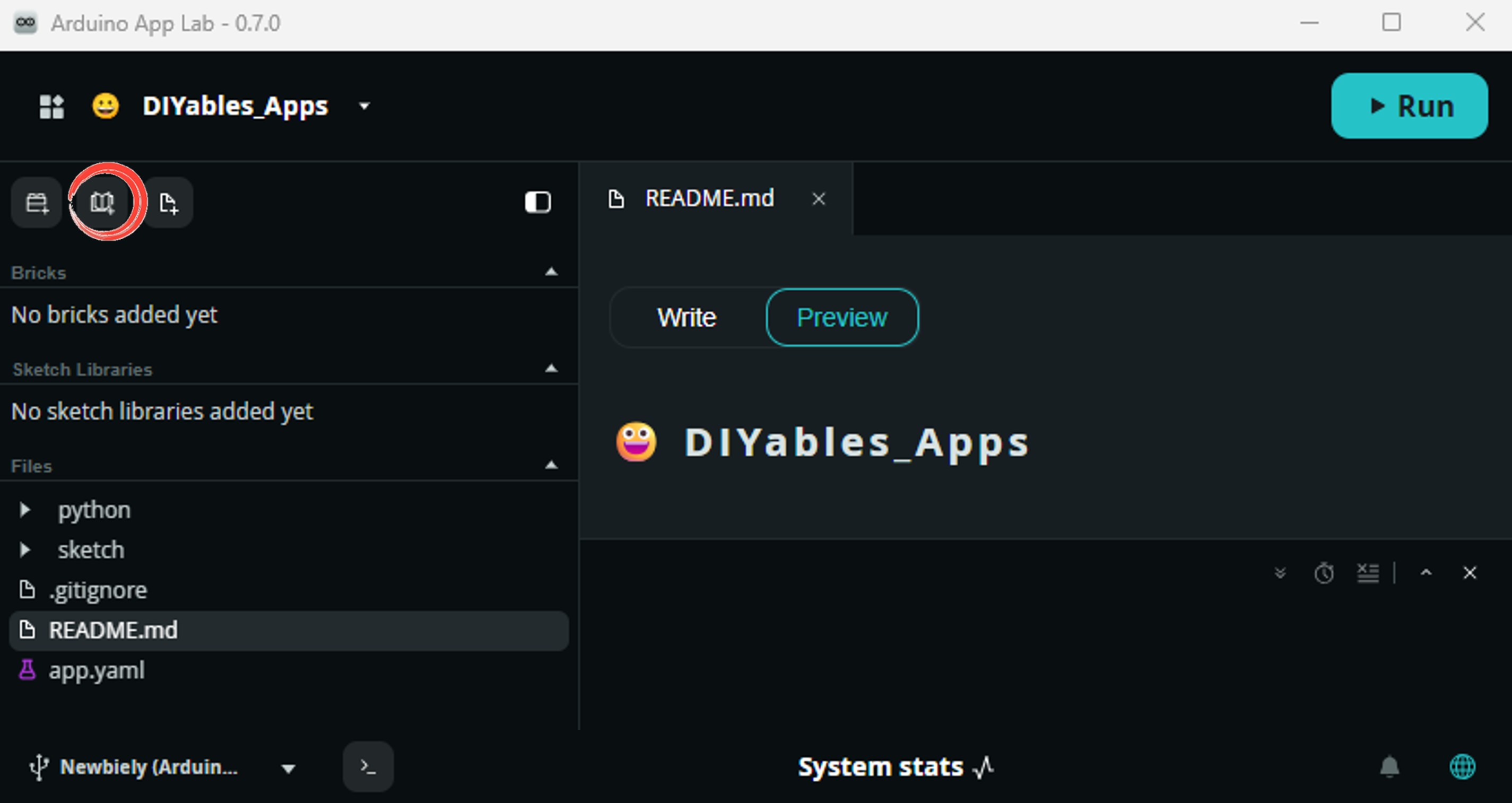
Add sketch library in Arduino App Lab on Arduino UNO Q
  • Search for Arduino_RouterBridge created by Arduino and click the Install button.
My Apps / DIYables Apps
Run
Bricks
No bricks added...
Sketch Libraries
No sketch libra...
Files
python
sketch
.gitignore
README.md
app.yaml
sketch.ino
Add sketch library
Arduino_RouterBridge Arduino

This library provides a simple RPC bridge for Arduino UNO Q boards, allowing communication between the board and other devices using MsgPack serialization.

0.4.1
Install
More Info
  • Upload: Click the Run button in Arduino App Lab.
Click Run button in Arduino App Lab on Arduino UNO Q
  • Watch the lock cycle: unlock → wait 5 seconds → lock → wait 1 second → repeat.

App Lab Console Output

DIYables_Apps
Stop
sketch.ino
1#include "Arduino_RouterBridge.h"
Serial Monitor
Python
Message (Enter to send a message to "Newbiely" on usb(2820070321))
New Line
9600 baud
[2026-04-29 09:00:01] Arduino UNO Q Solenoid Lock Bridge ready [2026-04-29 09:00:01] Initial state: LOCKED [2026-04-29 09:00:02] Solenoid lock: UNLOCKED [2026-04-29 09:00:07] Solenoid lock: LOCKED
DIYables_Apps
Stop
sketch.ino
1#include "Arduino_RouterBridge.h"
Serial Monitor
Python
[2026-04-29 09:00:02] Lock state: locked [2026-04-29 09:00:02] Unlocking... [2026-04-29 09:00:07] Locking... [2026-04-29 09:00:08] Lock state: locked

Telegram

Control the solenoid lock remotely via Telegram — lock and unlock from anywhere with a simple command.

MCU sketch: Keep the same MCU sketch from the previous Bridge section.

Python Code (Telegram)

/* * This Arduino UNO Q code was developed by newbiely.com * * This Arduino UNO Q code is made available for public use without any restriction * * For comprehensive instructions and wiring diagrams, please visit: * https://newbiely.com/tutorials/arduino-uno-q/arduino-uno-q-solenoid-lock */ # COPYRIGHT newbiely.com # AUTHOR: newbiely # This code is made available for public use without restriction. # For complete instructions, tutorials, and further information, visit: # https://newbiely.com/tutorials/arduino-uno-q/arduino-uno-q-solenoid-lock from arduino.app_utils import * import requests import time TELEGRAM_BOT_TOKEN = "YOUR_TELEGRAM_BOT_TOKEN" CHAT_ID = "YOUR_CHAT_ID" last_update_id = 0 def get_updates(): global last_update_id url = f"https://api.telegram.org/bot{TELEGRAM_BOT_TOKEN}/getUpdates" params = {"offset": last_update_id + 1, "timeout": 5} try: response = requests.get(url, params=params, timeout=10) data = response.json() if data["ok"]: return data["result"] except Exception as e: print(f"Error getting updates: {e}") return [] def send_message(chat_id, text): url = f"https://api.telegram.org/bot{TELEGRAM_BOT_TOKEN}/sendMessage" payload = {"chat_id": chat_id, "text": text} try: requests.post(url, data=payload, timeout=10) except Exception as e: print(f"Error sending message: {e}") def loop(): updates = get_updates() for update in updates: last_update_id = update["update_id"] if "message" not in update: continue message = update["message"] chat_id = message["chat"]["id"] text = message.get("text", "").strip() print(f"Received: {text}") if text == "/start": send_message(chat_id, "Arduino UNO Q Solenoid Lock Bot\n" "/unlock - Unlock the solenoid lock\n" "/lock - Lock the solenoid lock\n" "/state - Read current lock state") elif text == "/unlock": result = Bridge.call("unlock") send_message(chat_id, f"🔓 Lock state: {result}") elif text == "/lock": result = Bridge.call("lock") send_message(chat_id, f"🔒 Lock state: {result}") elif text == "/state": result = Bridge.call("get_state") send_message(chat_id, f"Lock state: {result}") else: send_message(chat_id, "Unknown command. Send /start for help.") time.sleep(1) App.run(user_loop=loop)

Detailed Instructions

  • Replace YOUR_TELEGRAM_BOT_TOKEN with your actual bot token from BotFather.
  • Replace YOUR_CHAT_ID with your Telegram chat ID.
  • Paste this Python code into your App's Python file (keep the same MCU sketch).
  • Click the Run button. Send /unlock from Telegram to open the lock, then /lock to close it again.

App Lab Console Output

DIYables_Apps
Stop
sketch.ino
1#include "Arduino_RouterBridge.h"
Serial Monitor
Python
[2026-04-29 09:10:00] Waiting for Telegram messages... [2026-04-29 09:10:05] Received: /unlock [2026-04-29 09:10:12] Received: /state [2026-04-29 09:10:20] Received: /lock
Telegram
Telegram 12:45
Welcome to Telegram!
ArduinoBot 10:19
Chatting with Arduino...
telegram-botfather
BotFather Yesterday
Your bot has been created.

ArduinoBot

bot
Today
/state
10:15 AM ✓✓
Lock state: locked
10:16 AM
/unlock
10:17 AM ✓✓
🔓 Lock state: unlocked
10:18 AM
/state
10:19 AM ✓✓
Lock state: unlocked
10:20 AM
/lock
10:21 AM ✓✓
🔒 Lock state: locked
10:22 AM

OpenClaw

...OPENCLAW

OpenClaw support for Arduino UNO Q Solenoid Lock is coming soon.

...OPENCLAW

Project Ideas

You can build many useful projects with the solenoid lock and Arduino UNO Q:

  • Telegram-Controlled Door Lock: Control your front door or office lock remotely using Telegram — /unlock to let someone in and /lock to secure it again, with all events logged with timestamps
  • Time-Based Auto-Lock: Program the MPU (Linux Python) to automatically lock at 10 PM and unlock at 7 AM every day — using the system clock on the Linux side to trigger Bridge commands
  • Keypad Access System: Combine the solenoid lock with a 4x4 keypad on the MCU — unlock when the correct PIN is entered, and send a Telegram alert whenever an incorrect PIN is tried three times in a row
  • Access Log System: Log every lock and unlock event to a CSV file on Linux — include timestamp, command source (Telegram or automatic), and generate daily reports sent to Telegram
  • Guest Access Manager: Create a time-limited unlock via Telegram — /unlock_5min unlocks the door and relocks it automatically after 5 minutes, with a Telegram confirmation sent when the timer expires

Challenge Yourself

Ready to go further with the solenoid lock on Arduino UNO Q? Try these challenges:

  • Easy: Add a Telegram /unlock_10s command that unlocks the lock for exactly 10 seconds using time.sleep(10) on the Python side before calling Bridge.call("lock").
  • Medium: Implement a Telegram /schedule command that parses a time argument (e.g., /schedule 23:00) and automatically locks the door at that time using the Linux system clock on the MPU.
  • Advanced: Build a multi-user access system: store a list of authorized Telegram user IDs in a Python file — only those users can send /unlock commands, and all unauthorized attempts trigger a Telegram alert to the admin's chat ID.

※ OUR MESSAGES

  • As freelancers, We are AVAILABLE for HIRE. See how to outsource your project to us
  • Please feel free to share the link of this tutorial. However, Please do not use our content on any other websites. We invested a lot of effort and time to create the content, please respect our work!