
Arduino Nano ESP32 - Web Apps Web Monitor

Overview

This tutorial covers the DIYablesWebMonitorPage class from the DIYables ESP32 WebApps Library. The page provides a terminal-style interface in the browser. Text sent from the sketch appears in the browser display; text typed in the browser is delivered to a sketch callback. This allows monitoring and commanding the Arduino Nano ESP32 from any device on the same network without a USB serial connection.
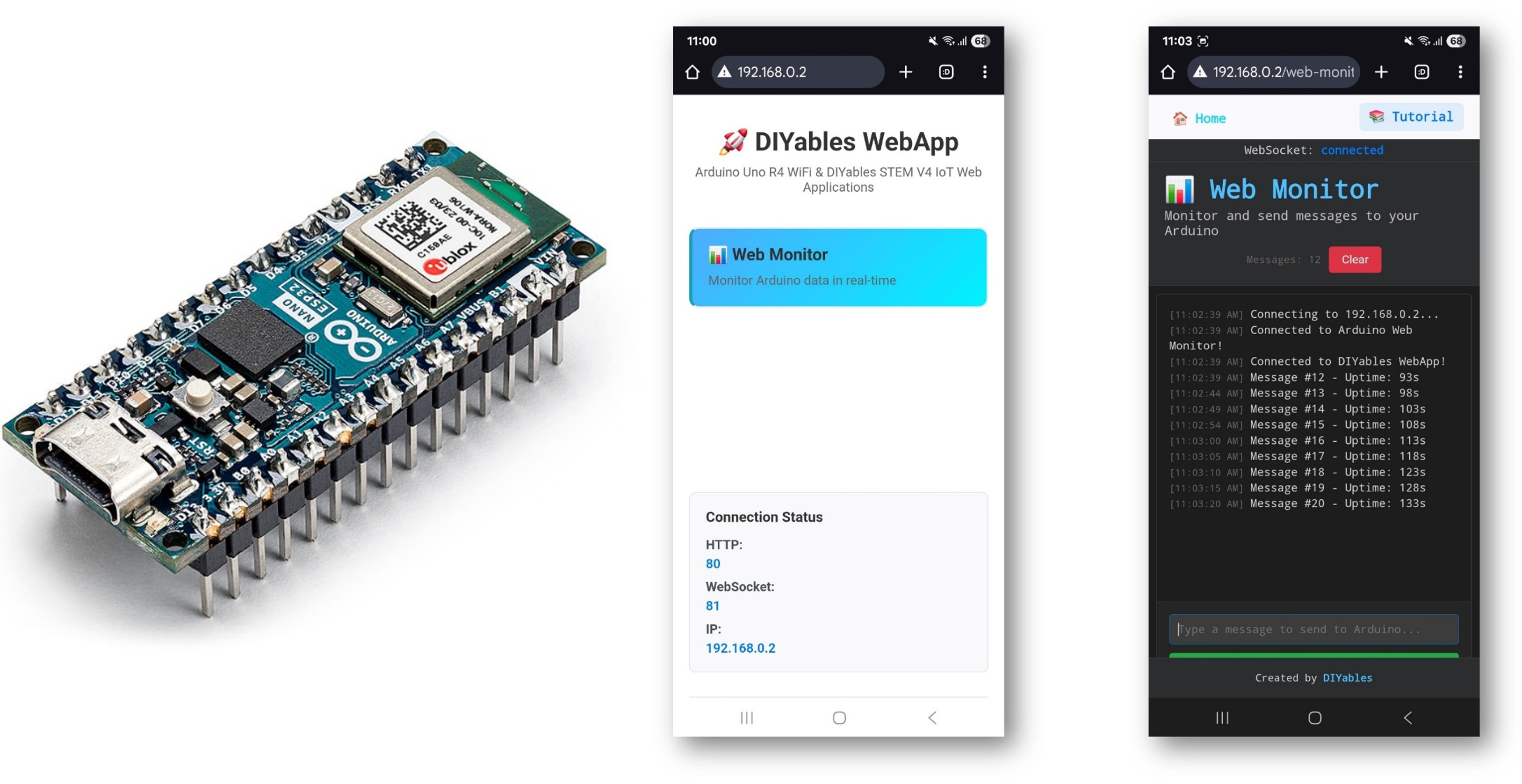
Arduino Nano ESP32 Web Monitor

Watch this step-by-step video tutorial demonstrating how to use WebMonitor with the DIYables ESP32 WebApps:

What This Tutorial Covers

  • Sending sketch output to the browser monitor using sendToWebMonitor()
  • Receiving browser-typed commands in a sketch callback
  • Processing built-in commands such as LED control and status queries
  • Accessing the monitor interface from a smartphone or PC

Hardware Preparation

1×Arduino Nano ESP32
1×USB Cable Type-A to Type-C (for USB-A PC)
1×USB Cable Type-C to Type-C (for USB-C PC)
1×Recommended: Screw Terminal Expansion Board for Arduino Nano
1×Recommended: Breakout Expansion Board for Arduino Nano
1×Recommended: Power Splitter for Arduino Nano ESP32

Or you can buy the following kits:

1×DIYables Sensor Kit (18 sensors/displays)
Disclosure: Some of the links provided in this section are Amazon affiliate links. We may receive a commission for any purchases made through these links at no additional cost to you.
Additionally, some of these links are for products from our own brand, DIYables .

Steps

Follow these instructions step by step:

  • If this is your first time using the Arduino Nano ESP32, refer to the tutorial on setting up the Arduino Nano ESP32 development environment.
  • Connect the Arduino Nano ESP32 board to your computer using a USB cable.
  • Launch the Arduino IDE on your computer.
  • Select the appropriate board (e.g. Arduino Nano ESP32) and COM port.
  • Navigate to the Libraries icon on the left bar of the Arduino IDE.
  • Search "DIYables ESP32 WebApps", then find the DIYables ESP32 WebApps Library by DIYables
  • Click Install button to install the library.
  • Search for DIYables ESP32 WebApps created by DIYables and click the Install button.
Newbiely | Arduino IDE 2.3.8
──
File
Edit
Sketch
Tools
Help
Arduino Nano ESP32
Library Manager
Type:
All
Topic:
All
DIYables ESP32 WebApps by DIYables
A comprehensive library designed for ESP32 that provides multiple professional web applications including Web Monitor, Chat, Digital Pin Control, Sliders, Joystick, Analog Gauge, Rotator Control, and Temperature Display via WebSocket communication. Features modular architecture for memory efficiency, automatic config handling, and perfect for IoT projects, robotics, sensor monitoring, servo/stepper control, temperature monitoring, and remote ESP32 control. More info
1.0.1
INSTALL
Newbiely.ino
···
1 void setup() {
Output
Serial Monitor
Ln 1, Col 1
Arduino Nano ESP32 on COM15
1
  • You will be asked for installing some other library dependencies
  • Click Install All button to install all library dependencies.
  • On Arduino IDE, Go to File Examples DIYables ESP32 WebApps WebMonitor example, or copy the above code and paste it to the editor of Arduino IDE
/* * DIYables WebApp Library - Web Monitor Example * * This example demonstrates the Web Monitor feature: * - Real-time serial monitor in web browser * - Send commands from browser to Arduino * - Automatic message timestamping * * Hardware: ESP32 Boards * * Setup: * 1. Update WiFi credentials below * 2. Upload the sketch to your Arduino * 3. Open Serial Monitor to see the IP address * 4. Navigate to http://[IP_ADDRESS]/webmonitor */ #include <DIYables_ESP32_Platform.h> #include <DIYablesWebApps.h> // WiFi credentials - UPDATE THESE WITH YOUR NETWORK const char WIFI_SSID[] = "YOUR_WIFI_SSID"; const char WIFI_PASSWORD[] = "YOUR_WIFI_PASSWORD"; // Create WebApp server and page instances ESP32ServerFactory serverFactory; DIYablesWebAppServer webAppsServer(serverFactory, 80, 81); DIYablesHomePage homePage; DIYablesWebMonitorPage webMonitorPage; // Demo variables unsigned long lastMessage = 0; int messageCount = 0; void setup() { Serial.begin(9600); delay(1000); Serial.println("DIYables ESP32 WebApp - Web Monitor Example"); // Add home and web monitor pages webAppsServer.addApp(&homePage); webAppsServer.addApp(&webMonitorPage); // Optional: Add 404 page for better user experience webAppsServer.setNotFoundPage(DIYablesNotFoundPage()); // Initialize LED for status indication pinMode(LED_BUILTIN, OUTPUT); // Start the WebApp server if (!webAppsServer.begin(WIFI_SSID, WIFI_PASSWORD)) { while (1) { Serial.println("Failed to start WebApp server!"); delay(1000); } } // Set up monitor callback for incoming commands webMonitorPage.onWebMonitorMessage([](const String& message) { Serial.println("Command from web: " + message); // Process simple commands if (message == "LED_ON") { digitalWrite(LED_BUILTIN, HIGH); webMonitorPage.sendToWebMonitor("LED turned ON"); return; } if (message == "LED_OFF") { digitalWrite(LED_BUILTIN, LOW); webMonitorPage.sendToWebMonitor("LED turned OFF"); return; } if (message == "STATUS") { String status = "Arduino Status: LED=" + String(digitalRead(LED_BUILTIN) ? "ON" : "OFF"); webMonitorPage.sendToWebMonitor(status); return; } if (message == "HELP") { webMonitorPage.sendToWebMonitor("Available commands: LED_ON, LED_OFF, STATUS, HELP"); return; } webMonitorPage.sendToWebMonitor("Unknown command: " + message); }); // Send welcome message webMonitorPage.sendToWebMonitor("Arduino Web Monitor ready!"); webMonitorPage.sendToWebMonitor("Type HELP for available commands"); } void loop() { // Handle WebApp server communications webAppsServer.loop(); // Send periodic updates to web monitor if (millis() - lastMessage > 5000) { // Every 5 seconds messageCount++; // Send sensor readings or status updates String message = "Message #" + String(messageCount) + " - Uptime: " + String(millis() / 1000) + "s"; webMonitorPage.sendToWebMonitor(message); lastMessage = millis(); } // Add your main application code here delay(10); }
  • Update the WiFi credentials in the sketch:
const char WIFI_SSID[] = "YOUR_WIFI_NETWORK"; const char WIFI_PASSWORD[] = "YOUR_WIFI_PASSWORD";
  • Click Upload button on Arduino IDE to upload code to Arduino Nano ESP32
  • Open the Serial Monitor
  • The Serial Monitor output should resemble the following:
Newbiely | Arduino IDE 2.3.8
──
File
Edit
Sketch
Tools
Help
Arduino Nano ESP32
Newbiely.ino
···
8 Serial.println("Hello World!");
Output
Serial Monitor
Message (Enter to send message to 'Arduino Nano ESP32' on 'COM15')
New Line
9600 baud
DIYables WebApp - Web Monitor Example INFO: Added app / INFO: Added app /web-monitor DIYables WebApp Library Platform: Arduino Nano ESP32 Network connected! IP address: 192.168.0.2 HTTP server started on port 80 Configuring WebSocket server callbacks... WebSocket server started on port 81 WebSocket URL: ws://192.168.0.2:81 WebSocket server started on port 81 ========================================== DIYables WebApp Ready! ========================================== Web Interface: http://192.168.0.2 WebSocket: ws://192.168.0.2:81 Available Applications: Home Page: http://192.168.0.2/ Web Monitor: http://192.168.0.2/web-monitor ==========================================
Ln 11, Col 1
Arduino Nano ESP32 on COM15
2
  • If nothing appears, press the reset button on the board.
  • Enter the IP address from the Serial Monitor into a browser on the same network.
  • Example: http://192.168.0.2
  • The home page shows a card for the monitor application:
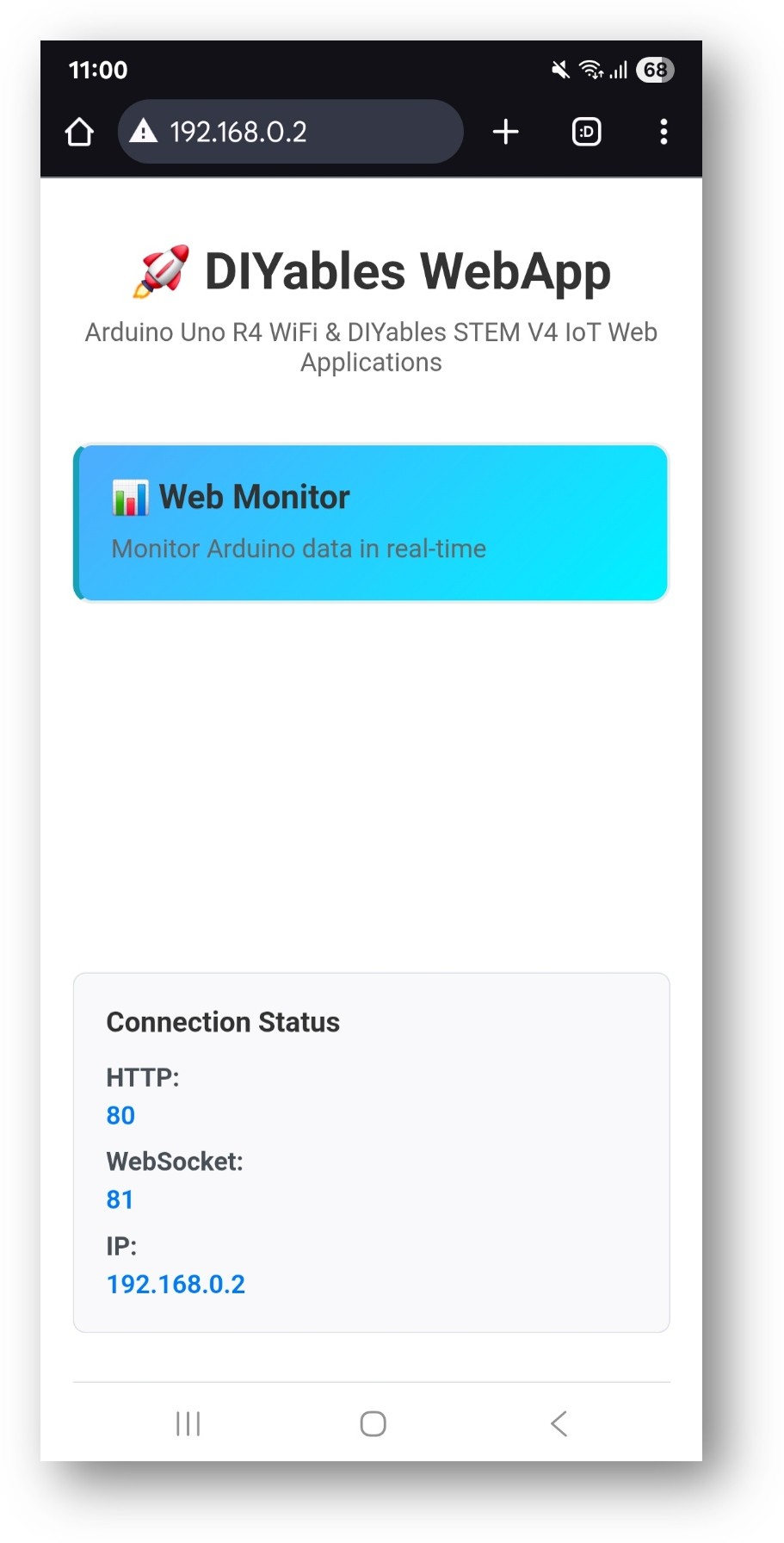
Arduino Nano ESP32 DIYables WebApp Home page with Web Monitor app
  • Select the Web Monitor card to open the terminal interface:
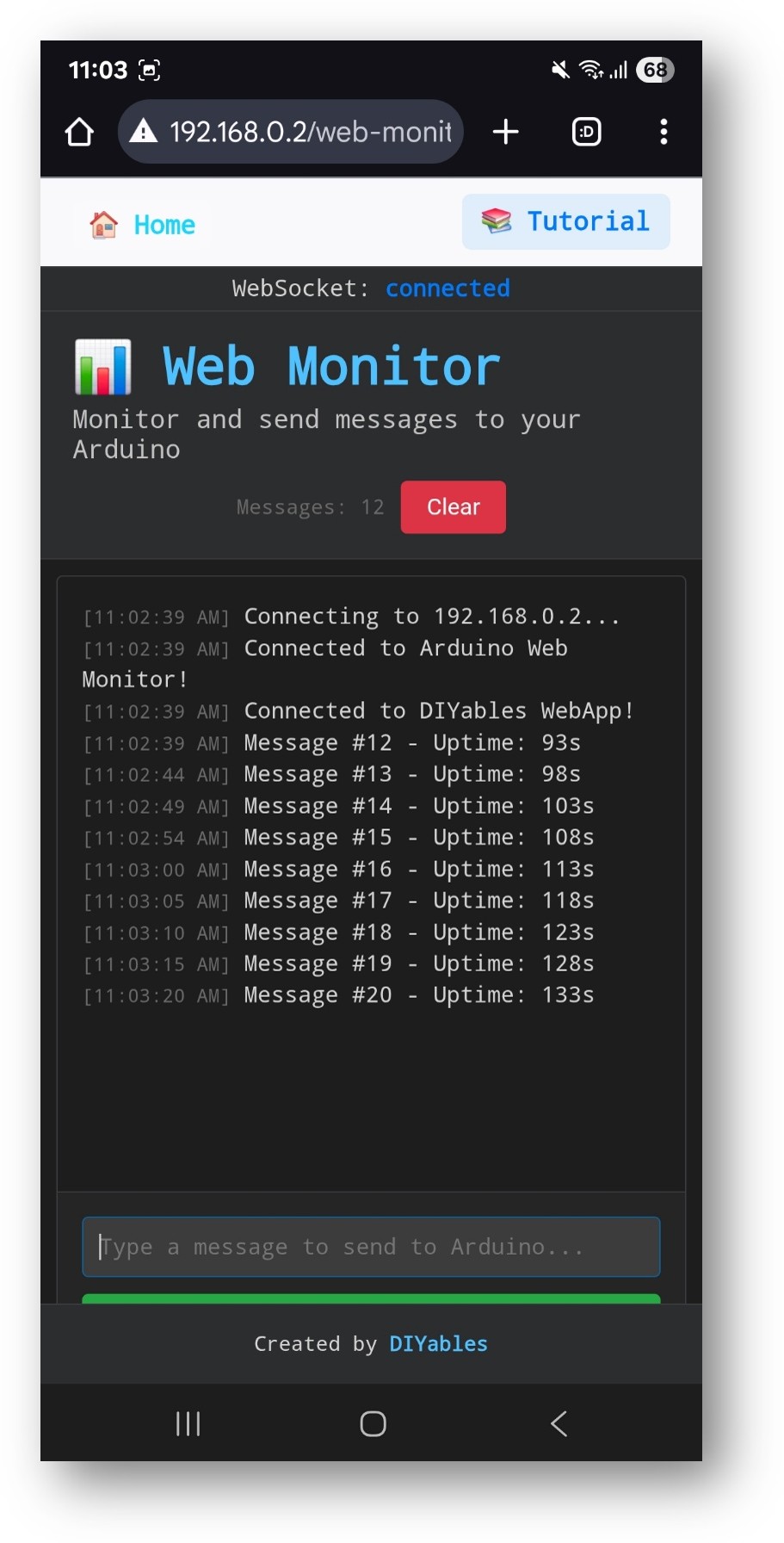
Arduino Nano ESP32 DIYables WebApp Web Monitor app
  • The page is also directly accessible at http://192.168.0.2/web-monitor.
  • Type commands in the input field and press Enter. The board responds and the reply appears in the terminal.

Built-in Commands

The example sketch recognizes the following commands entered in the browser:

Command Action
led on Turns on the built-in LED
led off Turns off the built-in LED
led toggle Toggles the LED state
blink Blinks the LED 3 times
status Prints board status and uptime
help Lists recognized commands
reset counter Resets the message counter
memory Reports free heap memory
test Sends a test message
echo [text] Returns the supplied text
repeat [n] [text] Repeats the text n times

Sending Data from the Sketch

Call sendToWebMonitor() anywhere in the sketch to push text to the browser:

void loop() { webAppsServer.loop(); // Send a periodic status message static unsigned long lastSend = 0; if (millis() - lastSend >= 5000) { lastSend = millis(); webMonitorPage.sendToWebMonitor("Uptime: " + String(millis() / 1000) + " s"); } }

Receiving Commands from the Browser

Register a callback to process text typed in the browser input field:

webMonitorPage.onWebMonitorMessage([](const String& command) { Serial.println("Received: " + command); if (command == "led on") { digitalWrite(LED_BUILTIN, HIGH); webMonitorPage.sendToWebMonitor("LED is now ON"); } else if (command == "led off") { digitalWrite(LED_BUILTIN, LOW); webMonitorPage.sendToWebMonitor("LED is now OFF"); } else { webMonitorPage.sendToWebMonitor("Unknown command: " + command); } });

Troubleshooting

Monitor shows no output from the sketch

  • Verify sendToWebMonitor() is being called; add a Serial.println() alongside it to confirm execution
  • Check the WebSocket status indicator in the browser
  • Ensure webAppsServer.loop() runs on every loop() iteration without blocking delays

Commands sent from browser are not received

  • Confirm onWebMonitorMessage is registered before webAppsServer.begin()
  • Check the Serial Monitor for the raw command text

Cannot open the page

  • Verify the IP address shown in the Serial Monitor
  • Ensure the browser device and board are on the same 2.4 GHz WiFi network

※ OUR MESSAGES

  • As freelancers, We are AVAILABLE for HIRE. See how to outsource your project to us
  • Please feel free to share the link of this tutorial. However, Please do not use our content on any other websites. We invested a lot of effort and time to create the content, please respect our work!